Legacy Code, Modern Velocity: Using AI-Driven Code Refactoring to Modernize Core Software
Published: 23 October 2026
Many established enterprises are held back by massive, multi-decade-old codebases. These legacy software systems—often written in older versions of Java, C++, or even legacy mainframe COBOL—served as the operational backbone of the business for years. Yet in today’s digital climate, these monolithic applications have become a severe limitation, resulting in high maintenance costs, slow deployment releases, and architectural rigidity.
Modernizing legacy applications is notoriously challenging. Traditional manual rewrite projects are high-risk, expensive, and can take years to yield results. To restore technical agility, organizations are leveraging AI-driven code refactoring engines to accelerate system migration. By combining automated AI translation tools with experienced interim migration teams, companies can systematically modernize their legacy software with minimal risk.
The True Cost of Technical Debt
The financial and operational costs of maintaining outdated systems accumulate rapidly:
- Engineering Squeeze: As older languages drop out of common university curriculums, finding development engineers who can safely maintain legacy code becomes difficult and expensive.
- Integration Gaps: Monolithic codebases struggle to interface with modern cloud services, AI tools, and APIs, limiting your ability to launch new product features.
- Security Exposures: Legacy libraries frequently contain unpatched security issues or rely on out-of-date security protocols that fail modern compliance audits.
- Deployment Delays: Testing a monolithic application requires compiling massive codebases and running extensive manual tests, slowing deployment velocity to a crawl.
Faced with these challenges, executives can find themselves trapped between maintaining a brittle system and funding a risky rewrite project, which often results in project delays or failures.
The Rise of AI-Driven Refactoring Engines
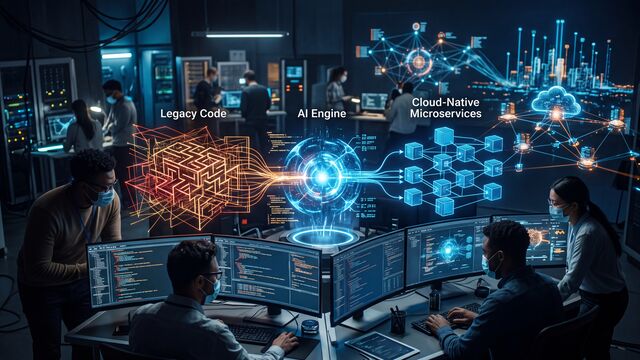
Artificial intelligence has unlocked a new paradigm for software migration. Modern Large Language Models configured specifically for code translation can analyze legacy code repositories, extract the underlying business logic, and rewrite the application in modern languages (like TypeScript, Python, or Go).
AI-driven refactoring tools operate systematically:
- Code Syntax Parsing: The refactoring engine analyzes the legacy structure, identifying dependency relationships, database queries, and custom configurations.
- Logic Translation: The AI translates the legacy code into clean, modular files that adhere to modern architectures, such as REST APIs or microservices.
- Automated Documentation: It generates detailed code documentation and diagrams explaining how the legacy logic has been mapped to the new system, capturing lost architectural knowledge.
- Test Script Synthesis: The AI automatically writes comprehensive unit and integration tests for the new code, matching the database outputs of the legacy system to ensure correctness.
By automating the mechanical translation of code, AI refactoring tools can accelerate software migration schedules by up to 70%, reducing project costs.
Setting Up a Secure Migration Pipeline
While AI-driven tools are powerful, they are not a complete solution. Blindly running a legacy codebase through a translation model and deploying the results can introduce software bugs and security issues.
To execute a successful migration, organizations must build a secure, multi-stage pipeline:
- Step-by-Step Migration: Never attempt to modernize the entire database and codebase at once. Identify small modules—such as a billing service or user notifications—and migrate them individually.
- Shadow Deployments: Deploy the new AI-generated microservice next to the legacy monolith in production. Route a small slice of traffic to both systems and verify that the outputs are identical before decommissioning the old code.
- Strict Security Verification: Run automated security scanners (SAST/DAST) on the translated code to ensure no security gaps were introduced during compile steps.
Integrating Interim Migration Experts
The most critical factor in software modernization is combining automation with human architectural strategy. AI tools excel at syntax translation, but they cannot design the overarching target architecture, manage database migrations, or coordinate team changes.
This is where specialized interim migration teams are essential. Bringing in seasoned engineering leaders from Aqon ensures that your AI-assisted migration is guided by experienced architects. Aqon’s experts help specify the target systems, choose the optimal cloud architecture, oversee integration pipelines, and train your internal developers on the new codebase. With this hybrid strategy, your organization can successfully modernize legacy software and restore technical agility.
Is legacy technical debt holding back your enterprise velocity? Contact Aqon today to learn how our interim migration teams can guide your AI-driven software modernization project.
Next Up: From Prototypes to Production: Navigating LLMOps for Highly Stable AI Applications
Latest Articles